
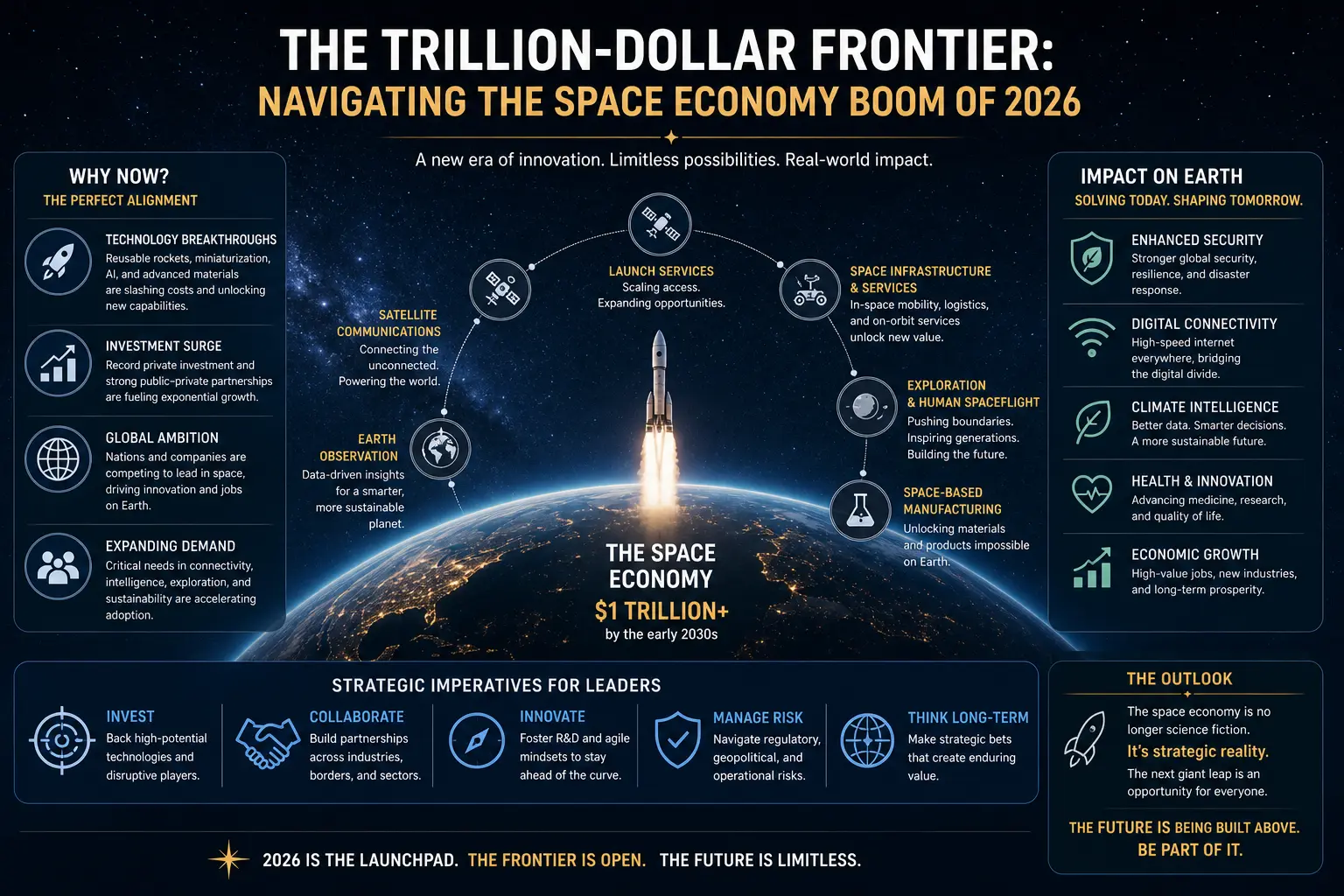
The Trillion-Dollar Frontier: Navigating the Space Economy Boom of 2026
Space is no longer merely a playground for sovereign governments. In 2026, it has cemented its position as the world's most competitive business vertical. We are shifting from the "LEO Economy" (Low Earth Orbit) toward a robust "Cislunar Economy" the industrial zone between Earth and the Moon.
Businesses that position themselves within this frontier today will likely dictate the parameters of global trade and connectivity for the next decade. The world's most competitive business vertical. According to recent industry analysis by McKinsey & Company, the space economy is rapidly evolving into a multi-trillion dollar sector.
Beyond the Hype: Defining the Commercial Space Sector
When the public thinks of the "Space Economy," they often visualize rockets and astronauts. However, the commercial reality is that nearly 70% of space revenue is derived from satellite-based services including global internet, GPS navigation, and Earth Observation (E.O.) data.
The Catalyst: Reduced Access Costs
The proliferation of reusable rocket technology has dramatically lowered the cost per kilogram to reach orbit. In 2026, launch cadences have become as predictable as commercial air travel. This accessibility has triggered an explosion in LEO satellite constellations.
Bureau Verification Tools
Analyst Insight: If you are evaluating a new satellite constellation or ground-based terminal software project, market entry cost remains the most volatile variable. Internal Link: Use our Startup Cost Calculator to project initial expenses for your aerospace-adjacent venture.
Key Sectors Driving Growth in 2026
1. Global High-Speed Broadband
Major constellations like Starlink and Kuiper have effectively globalized connectivity. This is no longer just about rural access it is about low-latency data for global financial markets and autonomous logistics.
-
Market Opportunity: The massive demand is now shifting toward application-layer software and edge-computing hardware that optimizes satellite data.
2. Earth Observation (E.O.) & Climate Intelligence
Satellites are now complex sensors. They provide real-time atmospheric data that drives supply chain management, precision agriculture, and ESG compliance. Corporations are increasingly using E.O. data to mitigate climate-related financial risks.
3. Commercial Spaceflight & Tourism
This sector is experiencing hyper-growth. From sub-orbital tourism to private modular space stations, demand currently outstrips supply. However, this sector requires high capital intensity and navigation of complex regulatory environments.
The Future: In-Orbit Economy and Lunar Resources
The post-2026 phase is defined by "In-Orbit Servicing." As assets in orbit age, private automated tugs will perform essential repairs and refueling. Looking further, lunar mining specifically the extraction of water ice to generate hydrogen-oxygen fuel will serve as the backbone for deep-space logistics.
-
Strategic Tip: Ensure your administrative documentation keeps pace with your technical scale. When managing multi-million dollar cross-border aerospace contracts, manual invoicing is an unnecessary risk.
-
Use our Invoice Generator to maintain professional, compliant billing standards for your international clients.
UP NEXT FOR YOU Business Scaling Strategies for Startups That Actually WorkStrategic Intelligence Business Scaling Strategies for Startups That Actually Work
-
Frequently Asked Questions (FAQ)
Q1: How can smaller businesses participate in the Space Economy?
A: Most SMEs enter as Tier-2 or Tier-3 suppliers. Opportunities include manufacturing specialized sensors, performing advanced data analytics on satellite imagery, or providing cybersecurity for ground stations.
Q2: Is the Space Economy recession-proof?
A: Only partially. While government defense contracts and long-term infrastructure projects provide stability, sub-orbital tourism and experimental manufacturing are highly sensitive to broader economic fluctuations.
Q3: What are the primary regulatory hurdles for an aerospace startup?
A: Hurdles include spectrum allocation licensing, international export control laws (such as ITAR), and orbital debris mitigation standards. Before finalizing your global web presence, verify that your site is prepared for international users with our Hreflang Generator.
international export control laws, and adherence to NASA’s space debris mitigation guidelines.

Bureau Discourse
Participate in the Analysis
Your contribution is subject to editorial moderation.